Step 2 — One ant asks the decision model
Deutsche Fassung · Translated from the German original.
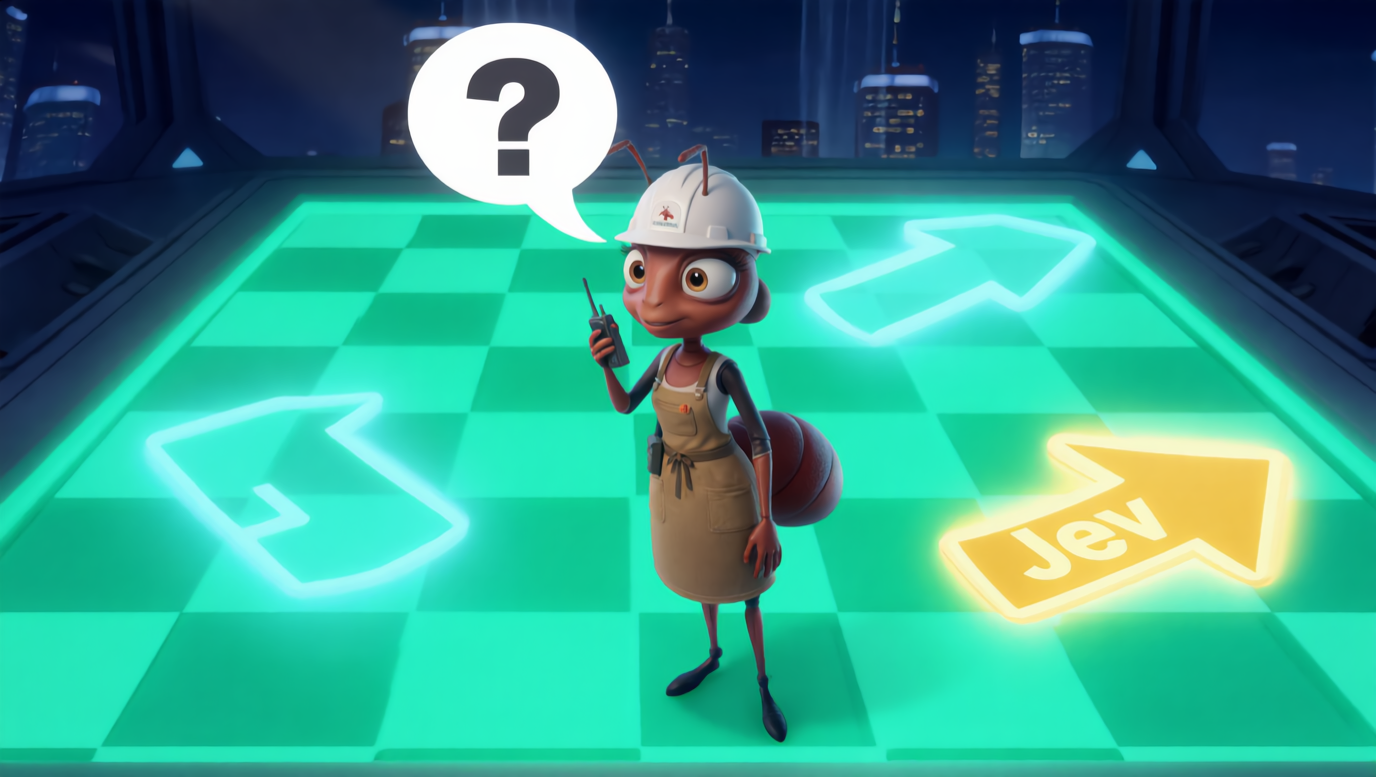
She asks, and the model shows her the way.
Goal: One ant stands on the board. You press a button, and the ant goes where the decision model tells it to — in this tutorial TypeSafe Jev.

One ant, and every step it has taken came from the decision model.
The API key
For requests to TypeSafe Jev you need a personal API key. You get it from the web page console.typesafe.ai/keys.
Either you write this key into the file .env.
TYPESAFE_API_KEY=your-key
Or into the sidebar of the running application. That is the way for everyone who later uses the game directly on the web: everybody brings their own key.
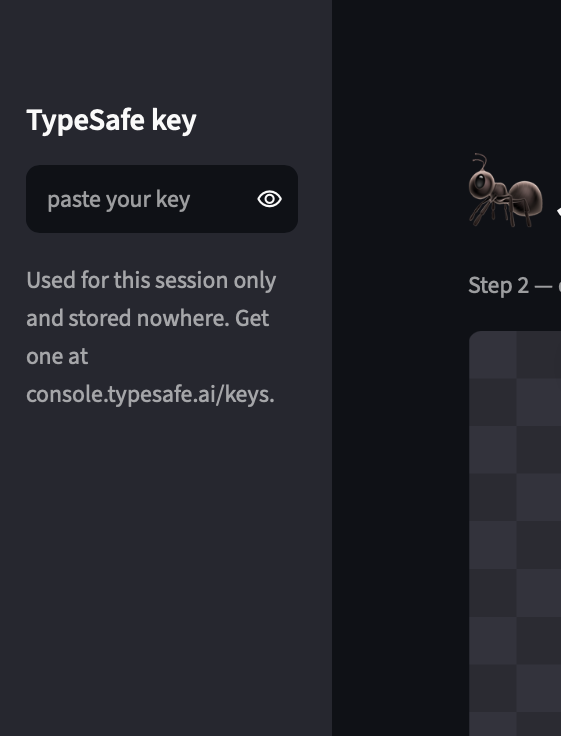
The field appears only when there is no key in .env — otherwise the sidebar
just shows “Found in .env”. The eye on the right makes what was pasted visible,
which after a botched paste is the only way to see the mistake without spending
a request on it.
import os
from dotenv import load_dotenv

load_dotenv()


def api_key() -> str:
    return st.session_state.get("typed_key", "").strip() or os.getenv(
        "TYPESAFE_API_KEY", ""
    ).strip()
What was typed takes precedence over the file .env — otherwise you could not
override a stale key there.
It works without a key, too. Since Ollama 0.35 a locally running model answers the same requests: no cost, no network, and not one line of code different — just three lines in
.env. How that works is in appendix B. If you would rather work through the tutorial that way, set it up there and come back here; everything else stays the same.
The ant
def start() -> None:
    if "ant" in st.session_state:
        return

    st.session_state.ant = {"x": COLUMNS // 2, "y": ROWS // 2}
    st.session_state.said = None
    st.session_state.failure = None
Streamlit runs the whole script again on every interaction. Every click: the file runs through again from top to bottom, and everything held in ordinary variables is gone.
Whatever is to survive a click must go into st.session_state — and may only
be written when it is not there yet.
That is exactly what this does:
if "ant" in st.session_state: return
It turns a rerun into a redraw instead of a restart.
The eight directions
DIRECTIONS = {
    "north": (0, -1),
    "north-east": (1, -1),
    "east": (1, 0),
    "south-east": (1, 1),
    "south": (0, 1),
    "south-west": (-1, 1),
    "west": (-1, 0),
    "north-west": (-1, -1),
}
y counts downwards (chapter 1), so north is (0, -1).
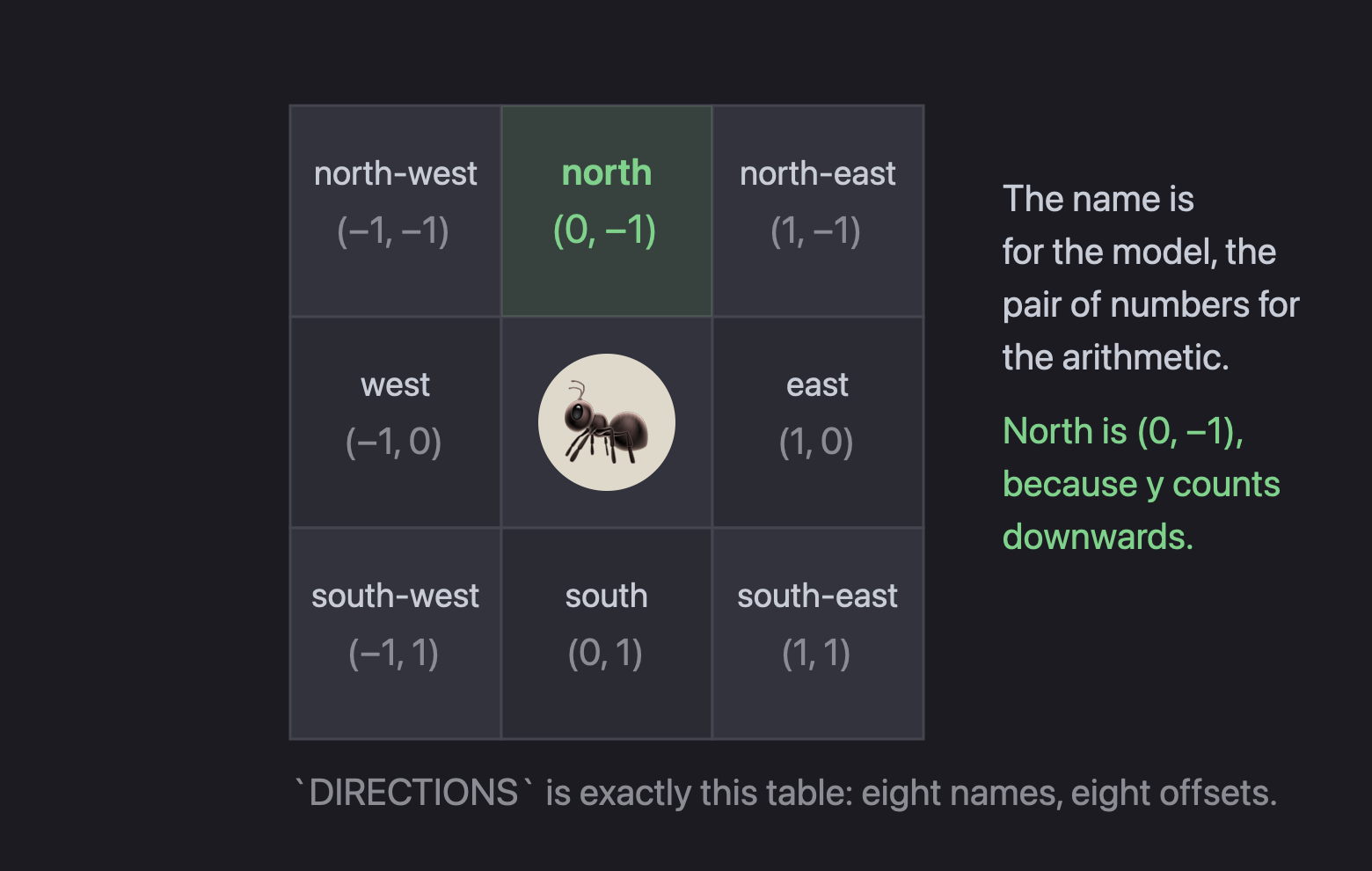
That the directions have names and are not numbered is a matter of readability and of communication. The ant queen, the player, can say: “All ants move north.” Coordinates would be no help here.
Beyond that, these names are what the decision model is offered to choose from
and what it gives back. "north-east" is a word a language model understands;
(1, -1) is not.
What this ant can do right now
def free_directions(ant: dict) -> list[str]:
    open_ways = []
    for name, (dx, dy) in DIRECTIONS.items():
        x, y = ant["x"] + dx, ant["y"] + dy
        if 0 <= x < COLUMNS and 0 <= y < ROWS:
            open_ways.append(name)
    return open_ways
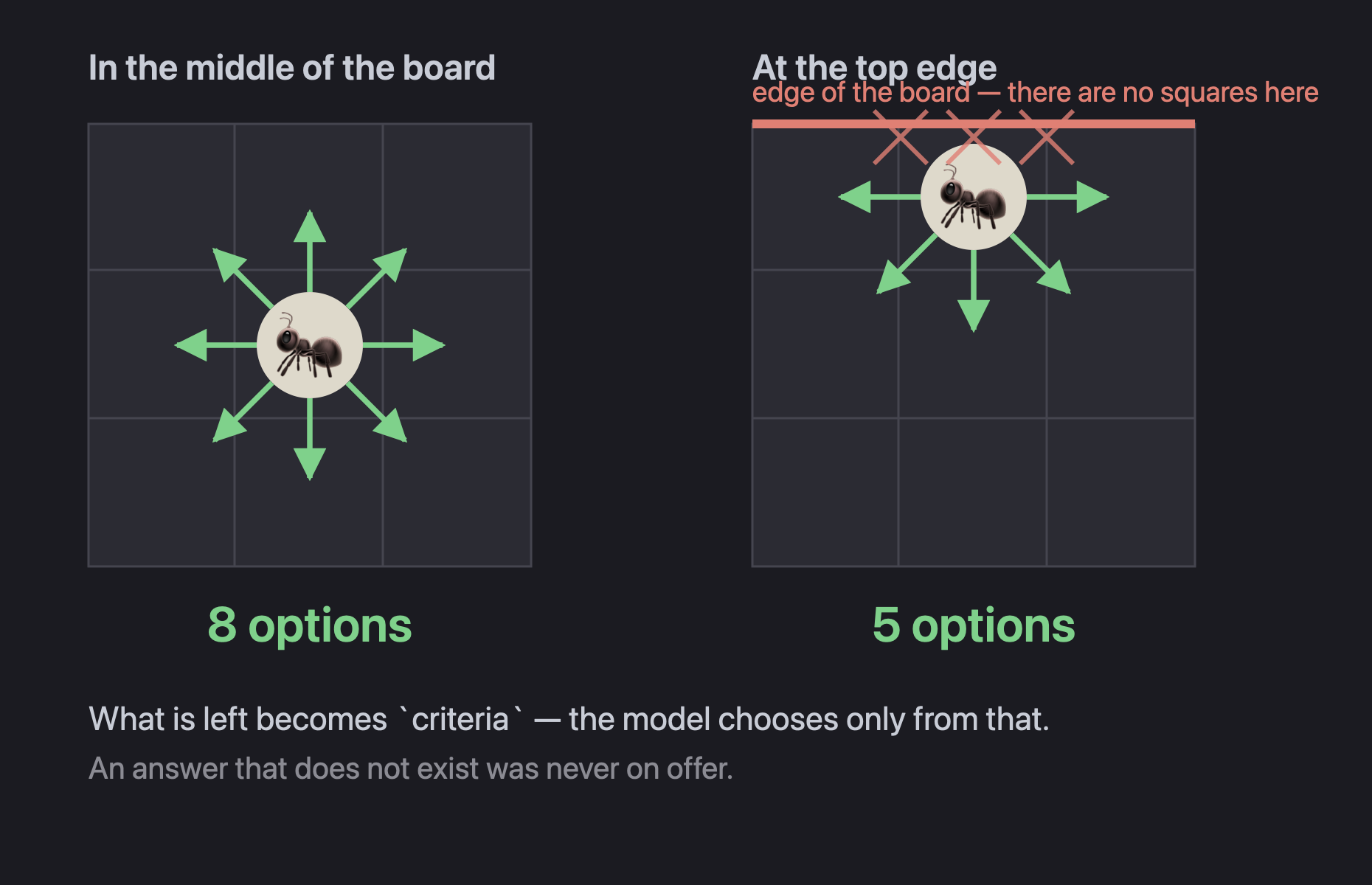
Exactly the green arrows become criteria. What is crossed out, the model
never gets to see.
This function works out which neighbouring squares of the ant are free and so come into question for the next step. On top of that it checks whether the edge of the board has been reached.
The question
STEP_QUESTION = (
    "An ant is standing on a board and has to decide where to go next. "
    "Which way should it go?"
)
This is the basic question that comes up at every step of the ant.
The request to the decision model
from typesafe_sdk import Choice, TypeSafeClient, TypeSafeError


def ask_jev(ant: dict) -> object:
    ways = free_directions(ant)

    state = {"the ant is": "standing on open ground"}
    questions = {
        "step": Choice(instructions=STEP_QUESTION, criteria=dict.fromkeys(ways))
    }

    client = TypeSafeClient(api_key=api_key(), timeout=15)
    return client.system_one(state=state, questions=questions)
A question to the decision model always consists of:
-
state: the basis for the model's decision. In this example the ant's current situation.
-
question: the question the model is to answer.
What is special about a decision model is that it does not answer with text like chat models do; instead you prescribe the data type of the answer.
Choice prescribes a selection, the criteria, from which the model picks one. For the ant these are the directions it can go in.
The options are made at runtime
criteria=dict.fromkeys(ways)
ways comes from the function free_directions. It is not a fixed list of
eight directions but what is possible for the ant right now. An ant at the
edge is not offered the edge.
dict.fromkeys(ways) contains {"north": None, "east": None, …}. The values
are descriptions that can be given to the options.
The state is as small as possible
state = {"the ant is": "standing on open ground"}
One entry. That is not laziness: a state padded with things that do not matter makes the answer worse — and costs money per word. Every line added in the next chapters has to justify itself.
One client, synchronous
The SDK offers TypeSafeClient and AsyncTypeSafeClient. The synchronous one
is enough here: Streamlit works through a script from top to bottom, and a
request that is waited for fits that exactly. The asynchronous one pays off
from chapter 3 on, when eight ants ask at the same time.
Taking the step
def take_a_step() -> None:
    ant = st.session_state.ant

    try:
        answer = ask_jev(ant)
    except TypeSafeError as failed:
        st.session_state.said = None
        st.session_state.failure = f"{type(failed).__name__}: {failed}"
        return

    step = answer.choices["step"]
    dx, dy = DIRECTIONS[step.choice]
    ant["x"] += dx
    ant["y"] += dy
    ...
answer.choices["step"] — the key is the same one the question was asked
under. Inside: choice, confidence and probabilities.
Every error the SDK knows is derived from TypeSafeError: wrong key, limit
exceeded, timeout. The class name goes into the message too, because
TypeSafeAuthenticationError means something quite different from
TypeSafeRateLimitError.
If the request fails, the ant stays where it is.
Showing the answer as well
    chosen, sure, tokens = st.columns(3)
    chosen.metric("Chosen", said["choice"])
    sure.metric("Confidence", f"{said['confidence']:.2f}")
    tokens.metric("Input tokens", said["tokens"])

    st.bar_chart(
        {"probability": dict(sorted(said["probabilities"].items()))},
        horizontal=True,
        height=260,
    )
The model's answers can also be seen in a bar chart. A clear answer is a tall bar.
An answer from the decision model
An answer to a real request:
| Model | jev-1.13.0 |
| Chosen | north |
| Confidence | 0.33 |
| Input tokens | 356 |
What confidence really measures
The value confidence says how the probability is spread over the options: if it all lies on one, it is 1. The more evenly it is spread, the smaller it gets, down to 0 for a completely even spread.
That is a fine but important difference from “how sure is the model that the answer is right”. The value says nothing about that. It only measures how clearly one option stands out. A model can be very sure and still be wrong — then the confidence is high and the answer is wrong.
Confidence in detail
TypeSafe's documentation gives the calculation for three options:
(3 × highest probability − 1) ÷ 2. Generalised, with n options:
confidence = (n × highest probability − 1) ÷ (n − 1)
Checked against a second real answer, the one in the picture below — eight
options, the highest at 0.37: (8 × 0.37 − 1) ÷ 7 = 0.28. The model reported
0.29; the rest is rounding, because the probabilities come with two decimal
places.
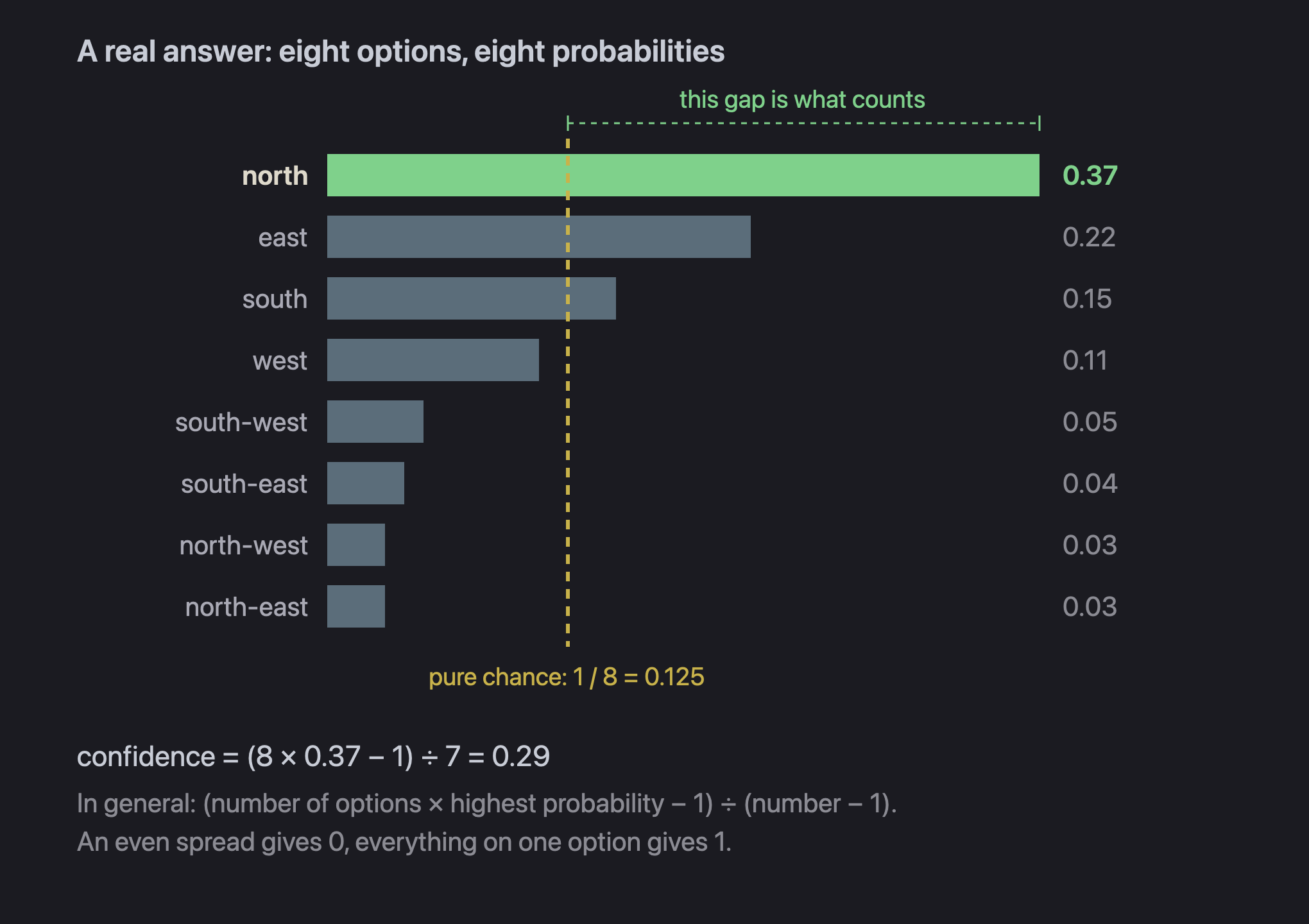
The divisor n − 1 is the reason why confidence must not be confused with
the highest probability: it takes the number of options out of the
calculation. 0.37 is three times chance with eight options, but with two
options it is less than half. That is exactly what this game needs, because the
number of options changes here with every step.
0.33 looks low at first glance, but it is actually right.
Ask yourself what the ant knows:
It is standing somewhere, and nothing else. It sees no goal (a fruit, say), because there is none. Nobody has told it anything. Under these circumstances one direction is as good as another — and the model says so by answering with a confidence of 0.33.
A high confidence would be the worse result here: a model that is sure without having a reason.
When may you follow an answer?
TypeSafe recommends three levels: below 0.5 the model is genuinely unsure and you should not guess; 0.5 to 0.9 means carry on, but with care; only above 0.9 may something risky happen. Which level applies depends on what a wrong decision does.
This game sets the threshold in chapter 5 at 0.22 — well below that. That is not a contradiction but the same reasoning: what an ant does with a wrong step is one wrong step. It costs a round and can be corrected in the next one. For a bank transfer or a cancellation, 0.9 would be too low.
These 0.33 are the number the rest of the tutorial wants to improve. Chapter 5 lets the ant see more, chapter 6 gives the queen a voice. Both should raise the value.
Try it
- Press several times. The answer wavers — at 0.33 confidence that is not a malfunction, it is the message.
- Walk the ant into a corner. There it has only three options left, and the chart has only three bars left too. That is the options made at runtime, in pictures.
- Change
STEP_QUESTIONto “Which way should it go? It is looking for food in the north.” and look at the confidence.
This tutorial was created by Gerhard Völkl using Claude Code (Anthropic). It is meant to help you learn more about what happens when ants ask a decision model. Suggestions for improvement are welcome at gkvoelkl@nelson-games.de.