Step 3 — The ant colony
Deutsche Fassung · Translated from the German original.
They all ask at once, and they all ask the same model.
Goal: Eight ants instead of one, the board read from a file, and a way asked of the decision model for all eight at the same time.
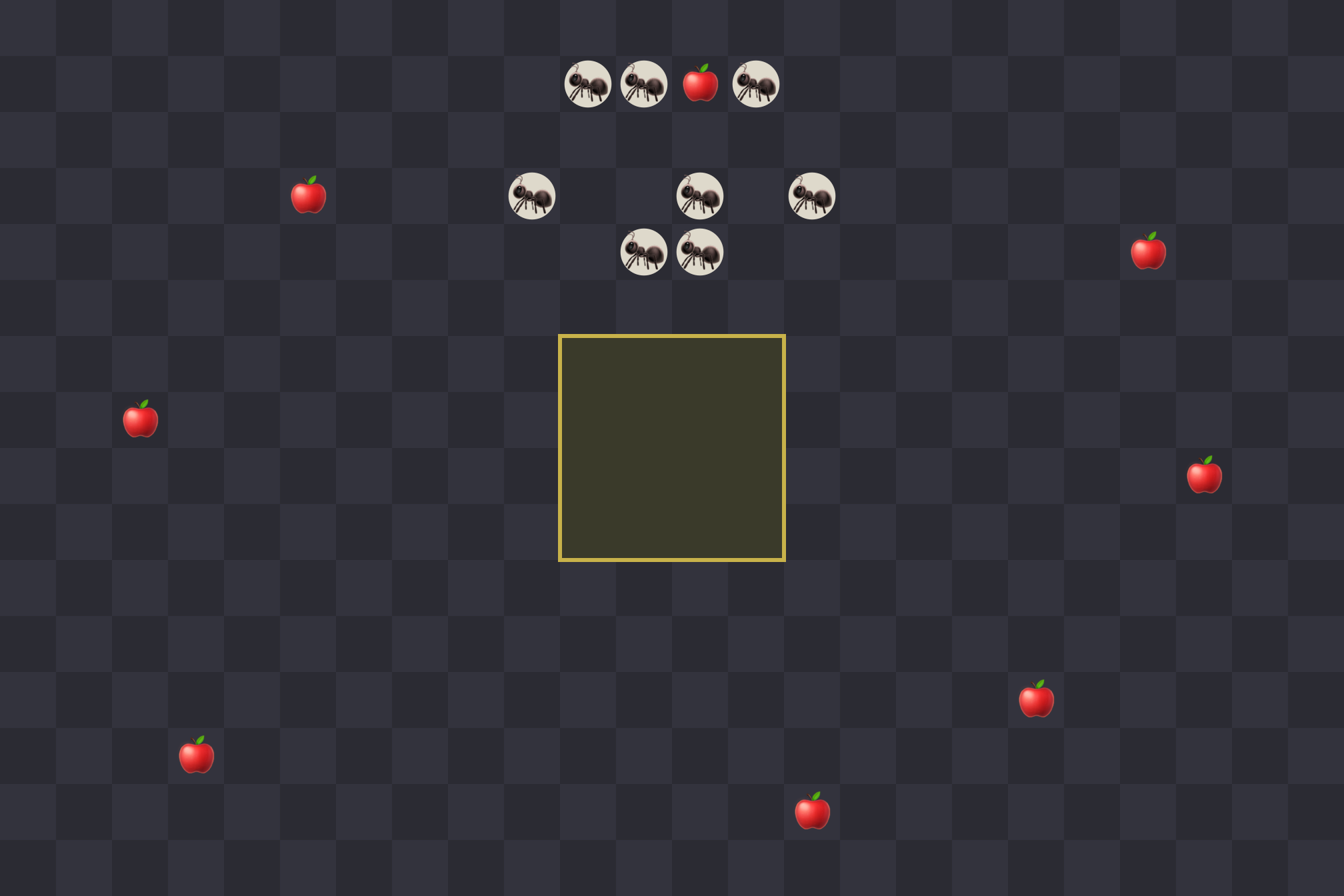
After five rounds. The fruit lies around, but nobody can do anything with it yet — that is chapter 4.
The approach from chapter 2 stays unchanged. What is new is the question of how to steer eight ants without a round taking four seconds.
The level as a file
In the first level the ants' task is to bring as much of their food (fruit) as they can into the nest.
level1.json:
{
  "name": "Fruit for the stores",
  "briefing": "Eight ants, fruit scattered about, nothing in the way. Get five of them home.",

  "columns": 24,
  "rows": 16,

  "nest": { "x": 10, "y": 6, "size": 4 },
  "ants": 8,

  "fruit": [
    [3, 13], [5, 3], [18, 12], [20, 4],
    [2, 7], [21, 8], [12, 1], [14, 14]
  ],

  "target": 5
}
This description of the level is kept in a file that the Python program reads at the start. That makes it possible to extend the game with any number of levels.
COLUMNS and ROWS disappear from the program, because they come from the
level file. That way levels can differ in size.
def load_level() -> dict:
    with open(LEVEL_FILE, encoding="utf-8") as file:
        return json.load(file)
Eight ants in the nest
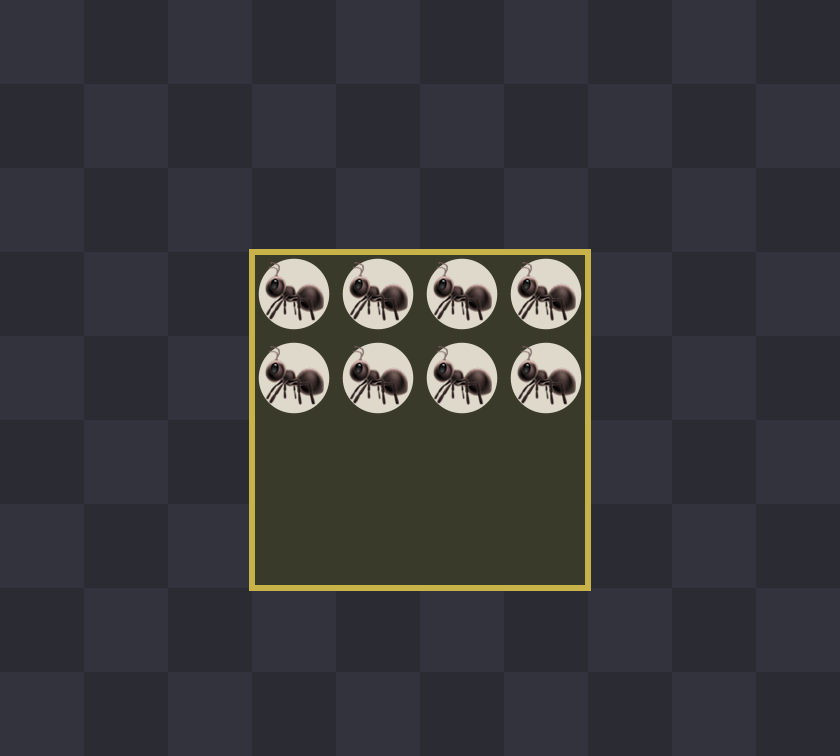
The starting line-up: i % size and i // size spread the eight over the
first rows.
    nest = level["nest"]
    st.session_state.ants = [
        {"x": nest["x"] + i % nest["size"], "y": nest["y"] + i // nest["size"]}
        for i in range(level["ants"])
    ]
    st.session_state.fruit = [tuple(cell) for cell in level["fruit"]]
    st.session_state.round = 0
i % size and i // size spread the eight over the first rows of the nest.
That they start there is not a whim of placement: the colony is at home and
waiting for a reason to do something.
Which square is already taken?
def taken_cells() -> set[tuple[int, int]]:
    return {(ant["x"], ant["y"]) for ant in st.session_state.ants} | set(
        st.session_state.fruit
    )
The program keeps in the set taken which squares (cells) already hold an ant or a fruit.
Ants and fruit go into one set, because for this question they answer the same thing:
May anyone step here? Is the square free?
free_directions gets the set taken added to its check:
def free_directions(level: dict, ant: dict, taken: set[tuple[int, int]]) -> list[str]:
    open_ways = []
    for name, (dx, dy) in DIRECTIONS.items():
        x, y = ant["x"] + dx, ant["y"] + dy
        on_board = 0 <= x < level["columns"] and 0 <= y < level["rows"]
        if on_board and (x, y) not in taken:
            open_ways.append(name)
    return open_ways
With that, the options the decision model gets are one step closer to reality: no edge, and no square that already holds an ant or a fruit.
Eight requests at once
This is where async pays off.
async def ask_everyone(payloads: list[tuple[dict, dict]], key: str) -> list[object]:
    async with AsyncTypeSafeClient(api_key=key, timeout=20) as client:
        return await asyncio.gather(
            *(client.system_one(state=state, questions=q) for state, q in payloads),
            return_exceptions=True,
        )
Eight requests, one per ant, one after the other at half a second each, add up to four seconds. Sent off at the same time (asynchronously), these requests bring all the answers back much faster.
Measured: about 0.6 seconds for a complete round.
return_exceptions=True makes sure that one ant's bad luck is not the
colony's: a failed request comes back as an exception object instead of
dragging the other seven down with it.
It is called from the ordinary, synchronous Streamlit flow with
asyncio.run(...).
The round
def next_round(level: dict) -> None:
    taken = taken_cells()
    payloads = [question_for(level, ant, taken) for ant in st.session_state.ants]
    answers = asyncio.run(ask_everyone(payloads, api_key()))

    for ant, answer in zip(st.session_state.ants, answers):
        ...
        dx, dy = DIRECTIONS[step.choice]
        target = (ant["x"] + dx, ant["y"] + dy)
        if target not in taken:
            taken.discard((ant["x"], ant["y"]))
            ant["x"], ant["y"] = target
            taken.add(target)

    st.session_state.round += 1
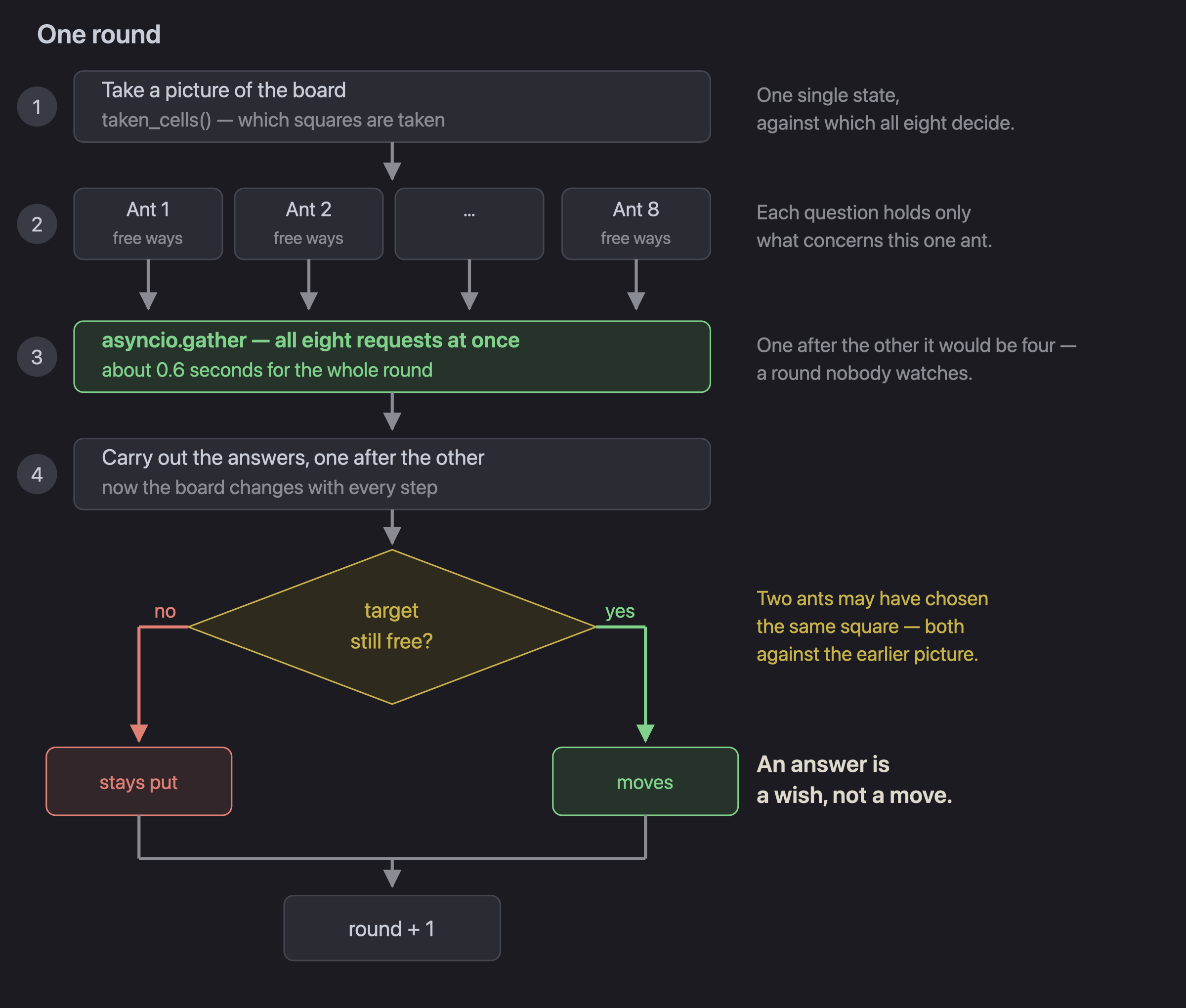
First all ask, then all act. That has a consequence that is easy to overlook: every answer is decided on the basis of the same board.
If two happen to choose the same square, the check if target not in taken
catches it when the moves are carried out.
An answer is a wish, not yet a move.
Drawing
The nest gets an outline instead of a fill:
    nest_svg = (
        f'  <rect x="{nest["x"] * CELL}" y="{nest["y"] * CELL}" '
        f'width="{nest["size"] * CELL}" height="{nest["size"] * CELL}" '
        f'fill="{NEST_FILL}" stroke="{NEST_EDGE}" stroke-width="2"/>'
    )
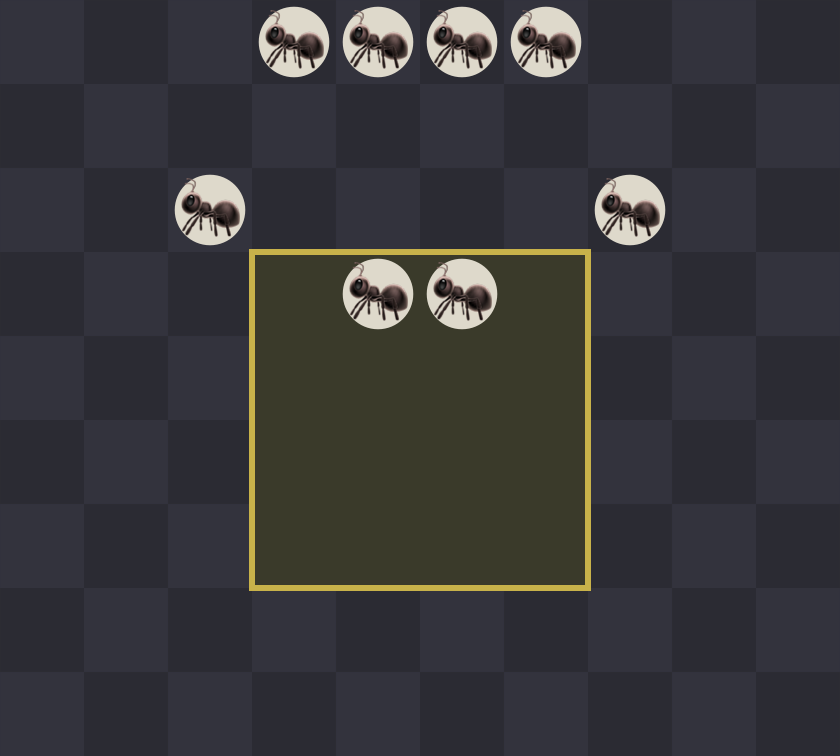
Three rounds later. You can see why the nest is an outline and not a fill: the ants walk through it and beyond. A solid block would look like an obstacle.
Emojis are well suited for drawing the game pieces. The fruits are 🍎 and the ants are 🐜. The ants also get a light background, so that they are easier to spot on the board.
    fruit_svg = "\n".join(cell_text(x, y, "🍎") for x, y in st.session_state.fruit)
    ants_svg = "\n".join(
        cell_disc(ant["x"], ant["y"]) + "\n" + cell_text(ant["x"], ant["y"], "🐜")
        for ant in st.session_state.ants
    )
With emojis as game pieces you save yourself extra image files.
Try it
- Press “Next round”: the colony comes out of the nest. The answers are shown
below — my first round was
north 0.39 · north 0.68 · north 0.67 ·
  north 0.37 · west 0.26 · south 0.30 · south 0.32 · east 0.29
. - Four of eight wanted to go north. At this confidence that is not a plan but a slight lean of the model when nothing steers it.
- Press “Five rounds” and look at the clock — eight ants times five rounds are forty requests in a few seconds.
- Change
"ants"inlevel1.jsonto 20 and reload. Nothing happens, becausestart()only sets up the colony when there is none. That is what “Start over” is for — and with twenty ants in the nest you will see how tight it gets.
This tutorial was created by Gerhard Völkl using Claude Code (Anthropic). It is meant to help you learn more about what happens when ants ask a decision model. Suggestions for improvement are welcome at gkvoelkl@nelson-games.de.