Step 8 — What is the decision model worth?
Deutsche Fassung · Translated from the German original.
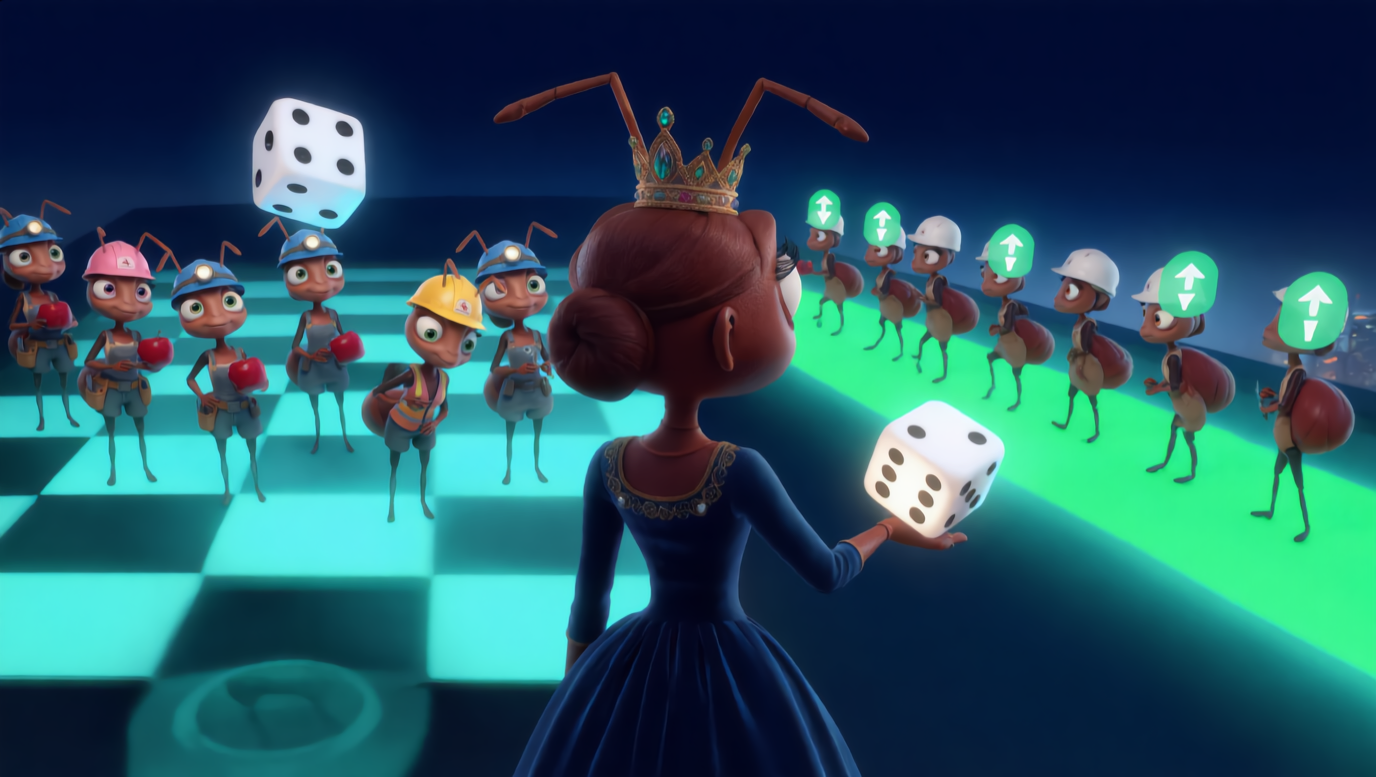
Random moves (the dice) compared with the decision model — the same ants, the same paths.
Goal:
- A switch that replaces the decision model with a dice.
- The same colony, the same board, the same options — only nobody decides any more; chance does.
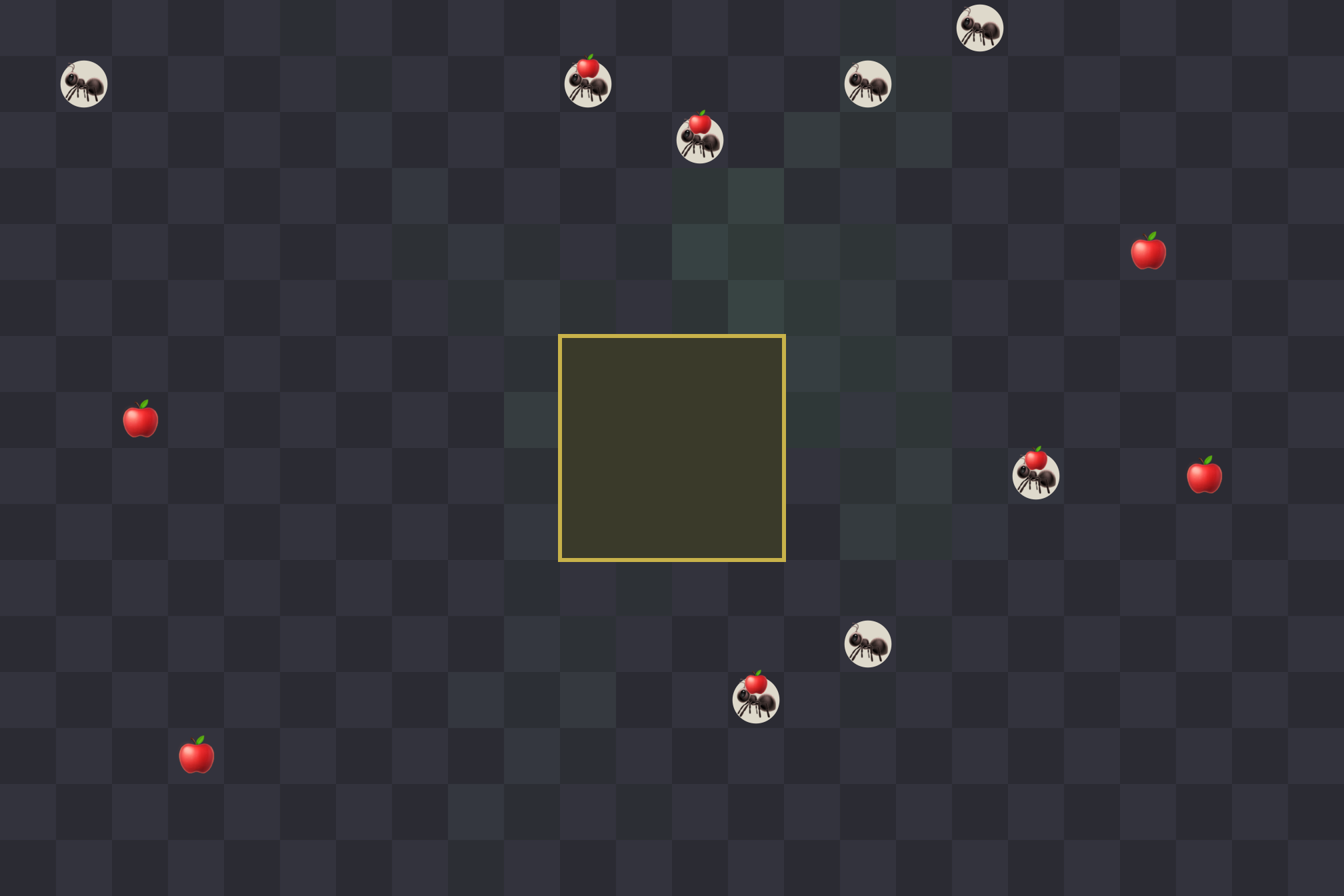
Forty rounds of chance: four fruits on the way, none in the stores.
Throughout the tutorial a model has decided, and it looked good.
“Looked good” is not an objective statement, not a measurement. This chapter builds the yardstick against which the model can be measured.
A dice that gets the same options
def decide_with_dice(level: dict, taken: set[tuple[int, int]]) -> list[str | None]:
    ways = []
    for ant in st.session_state.ants:
        open_ways = free_directions(level, ant, taken)
        ant["said"] = None
        ways.append(random.choice(open_ways) if open_ways else None)
    return ways
What matters is free_directions. That is the same function from which
options() builds the choice for the decision model.
The dice gets as its input what the model would have been shown — only without the descriptions, because it cannot read them.
So the difference is the choosing itself, not what there is to choose from.
ant["said"] = None makes sure that no label from an earlier round is left
standing above an ant.
One line decides
def next_round(level: dict) -> None:
    taken = taken_cells()
    decide = decide_with_dice if st.session_state.dice else decide_with_jev

    for ant, way in zip(st.session_state.ants, decide(level, taken)):
        ...
Every round gets a list of directions and carries them out — with the same check when moving as since chapter 3, because a dice can send two ants to the same square too.
The switch
    st.session_state.dice = st.toggle(
        "A dice instead of Jev",
        value=st.session_state.dice,
        help=(
            "Draws blindly from the same options the model would have been "
            "given. Nothing is asked and nothing is paid. It is a yardstick, "
            "not a fallback."
        ),
    )
    if st.session_state.dice:
        st.caption("Nobody is being asked. Watch how long five fruits take now.")
When the switch is on, two locks fall away:
ready = (st.session_state.dice or (bool(api_key()) and st.session_state.awake)) and not won
With the dice you need neither a key nor an order — nobody is asked, after all. That is exactly what makes it usable as a yardstick.
Two hundred runs without Streamlit
In the game itself you can see the difference. Measuring it there is awkward: every round is a click, and a run with the dice takes hundreds of them.
tutorial/baseline.py plays the dice rules without Streamlit and without
drawing — two hundred runs in a second:
python3 tutorial/baseline.py
200 of 200 runs brought five fruits home
median    240 rounds
mean      248 rounds
range     75 to 603
middle 80% 146 to 361
Your numbers will look a little different; the dice is a dice, after all. But over two hundred runs the median stays somewhere around 240.
The result
For the model, three runs with the same order, “Fan out and search, and carry what you find straight home.”:
| Run | Rounds | Requests | discarded | Cost |
|---|---|---|---|---|
| 1 | 59 | 472 | 222 (47 %) | $0.0100 |
| 2 | 23 | 184 | 68 (37 %) | $0.0040 |
| 3 | 26 | 208 | 74 (36 %) | $0.0045 |
| Rounds to five fruits | |
|---|---|
| Dice (median of 200 runs) | 240 |
| Decision model (Jev), median of 3 runs | 26 |
The model is about nine times faster. A whole game costs between half a cent and a cent.
The first run shows how much spread there is with the decision model too: more than twice as long as the other two, and almost every second answer was thrown away. It was still faster than the fastest dice run (75 rounds).
Where does the big gap come from?
Not from picking up: a fruit right next to an ant is picked up in both
colonies without anyone deciding (pick_up_and_deliver from chapter 4).
A small part comes from the model heading for a fruit it sees three squares away. The dice walks past it.
But the big part comes on the way home. A carrying ant follows the scent trail uphill and arrives. A dice would have to hit the 16 squares of the nest among 384 squares by wandering about. You can see it in the picture above: four ants are carrying a fruit, none finds its way home.
And now comes the subtlety that makes this comparison sharp: the dice colony
lays the same trail. lay_scent hangs on walking, not on deciding, so its
board smells just the same — the picture shows that too. It just cannot read
the trail, because for that someone would have to choose something from what
is on offer.
So the trail is not what makes the difference. It is only the information — and the difference is that one side can make use of it and the other cannot.
Remember the general part of this: the benefit was not where the decision looked difficult, but where there was information that chance cannot make use of.
Limitations
The numbers are not measured on equal terms. 240 is an average (median) of two hundred runs, the 26 for the decision model a median of three, because each of them costs several hundred requests.
The runs spread from 23 to 59 rounds. Before you take a number for the model seriously, you should do more runs — and also try out how much difference another order makes.
The claim lies elsewhere. What the rule cannot do: respond to “Leave the fruit in the north alone”. Or to “Stay together”. Or to a sentence you have only just thought of. That is what the text field from chapter 6 is for, and that is what the whole thing is built for.
Try it
- Switch on, “Five rounds” a few dozen times. It costs nothing, and it takes a while. That is exactly the message.
- Switch off, “Start over”, say a good sentence and count the rounds.
- Open
tutorial/baseline.pyand build in the rule that is missing above: fruit in sight → go there; carrying → go home. How many rounds does it need? - Set
RUNSto 20 and run it twice. The medians will differ — with this much spread, twenty runs say little. That is the most important lesson about measuring in this tutorial.
Done
Eight steps, one game. What stands there now:
- a board in SVG that draws a level from a JSON file
- options that are made anew every round from the situation of each single ant — the model never gets to see anything impossible
- eight parallel requests per round in a little over half a second
- a colony that finds fruit, carries it and brings it home
- a threshold below which answers are thrown away and counted instead of hidden, and no falling back on rules underneath
- a text field into which you type a sentence that each of the eight ants reads for itself
- the display that shows whether it helped
- and a yardstick against which all of it can be measured
Where it could go next
- A second level is already included:
level2.json. Nothing more than a second file was needed; you play it by changing one line inapp.py:
LEVEL_FILE = "level2.json"
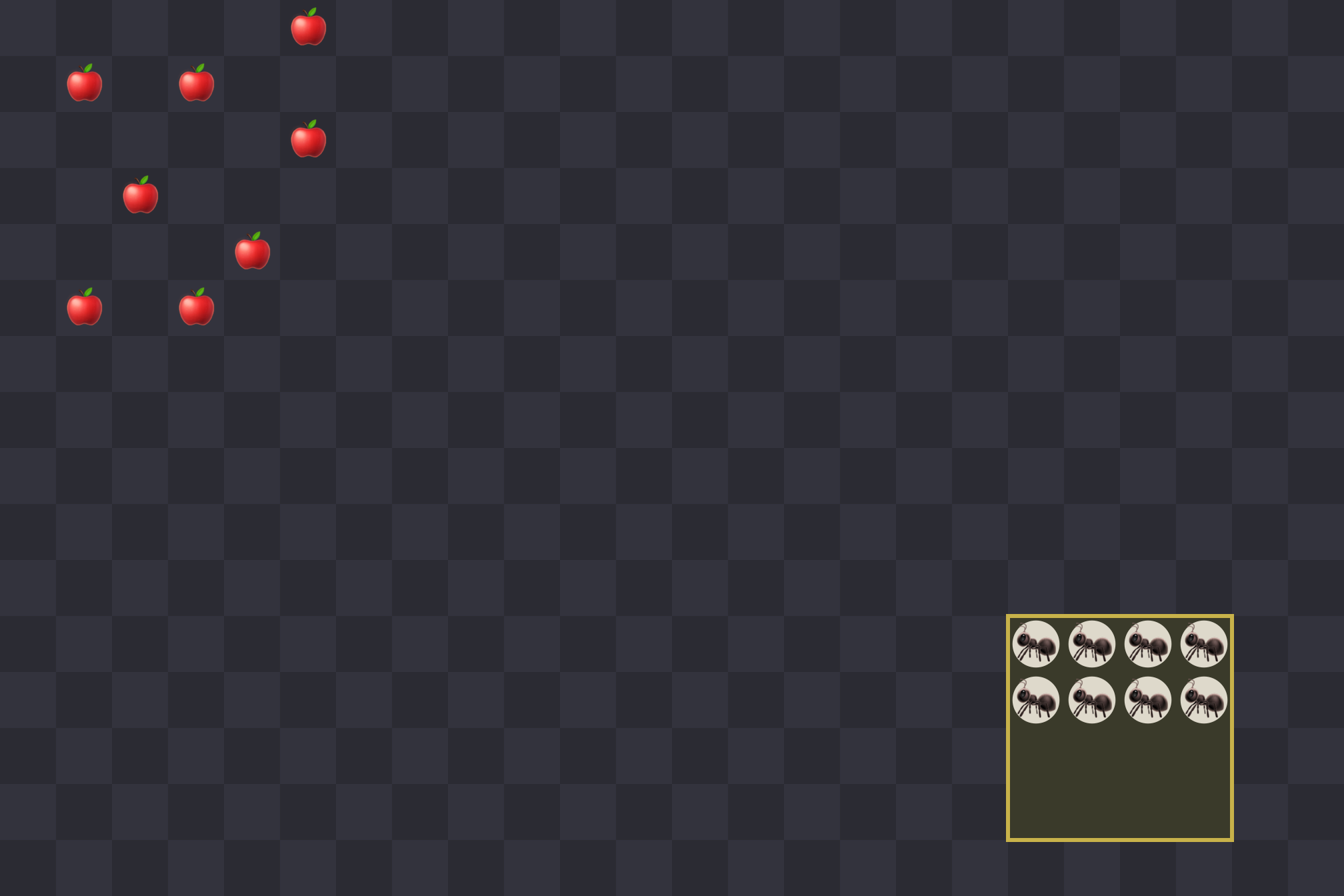
The nest is in the south-east, all the fruit in the north-west — 13 to 17 squares away, with a vision range of three. With a vague order the colony searches an empty board. With “The fruit lies far to the north-west, go there” it has a direction. The rules are the same as in the first level, only without the chance of getting lucky by wandering about.
- An obstacle. The Rust version has a level with a river and a plank that two ants have to carry together — coordination without agreement is the most interesting part of the whole thing. Appendix A shows how far this can be rebuilt here.
- Intents instead of single steps. Instead of asking “which direction?” every round, ask once “fetch the fruit in the north-east” and let the ant work on it for several rounds. That saves most of the requests.
- Refining the question. The most rewarding point and the cheapest:
turning the knobs on
STEP_QUESTIONcosts not one line of code and changes the behaviour of the whole colony. One of the exercises in chapter 5 shows it: take out the sentence about fanning out, and the colony behaves differently.
This tutorial was created by Gerhard Völkl using Claude Code (Anthropic). It is meant to help you learn more about what happens when ants ask a decision model. Suggestions for improvement are welcome at gkvoelkl@nelson-games.de.